
Most dealership groups don’t need a custom CRM. An established automotive product is the sensible place to begin when the job is lead capture, assignment, follow-up, messaging, appointments, desking, and group reporting. Custom work becomes worth examining when an important rule about who can see, own, or act on a customer keeps pushing work into spreadsheets or chat.
We came to that answer from an awkward position because we’ve built a custom showroom CRM.
The reason was narrow, which is what made the project useful for this decision.
Our custom build started with one narrow rule
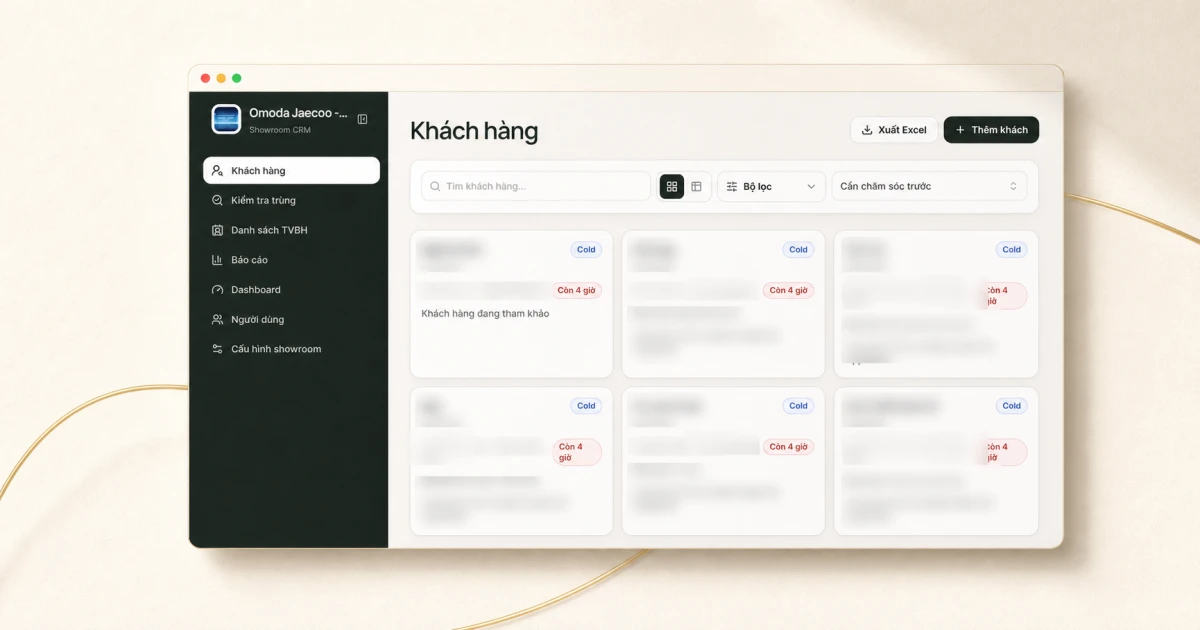
The customer list in the CRM we built for Omoda & Jaecoo Vinh is designed to answer a practical question: who needs care next? A customer record may contain a quote, a test drive, a finance discussion, and several notes while still leaving the next call buried.
Our published case study explains the rule we built around. A recorded interaction sets a ten-day care deadline, customers closest to that deadline appear first by default, and ownership sets the access boundary. A manager can move from a performance view to the customer history behind it.
That rule worked for one showroom, and we wouldn’t copy the ten-day clock into another group without seeing how its sales team works (a longer sales cycle might make it annoying). We also haven’t published a controlled conversion result, so the case doesn’t prove that a custom CRM sells more cars.
Current products cover most of the ordinary work
As of September 2026, DealerSocket says its CRM can route and rank leads, keep calls, texts, and emails on the customer record, run task queues, report across rooftops, and connect with a DMS (dealer management system), inventory tools, a dealer website, and desking products. Those are vendor claims rather than our assessment, but they show how much should be tested before a group commissions a replacement. The details are in Solera’s DealerSocket product page.
Even a general CRM can handle a common assignment rule. HubSpot documents rotation among selected users or teams, including an option to overwrite an existing owner. Its owner-assignment documentation also names the required subscriptions, paid seats, and team-membership rules. A group should check those limits in its own account rather than infer them from a feature name.
We would try to buy round-robin ownership, overdue tasks, customer timelines, test-drive bookings, and group dashboards. Rebuilding them creates migration, security, training, and support work without making the dealership’s sales method distinctive.
Vendor documentation still can’t tell us how well those features fit your group.
A lead transfer is a better test than a feature list
A useful demo could follow one customer arriving through the group website. The CRM knows the model, assigns a sales rep, starts a task, and keeps the messages. Then the customer wants a colour held at another location. The first manager hands over the lead, the second showroom books a drive, and everybody should still see one history.
The useful part of the demo begins when that clean path meets the group’s real exceptions. We would test what happens when the first rep is away, stock moves after assignment, or two stores believe they own the same customer.
We’d want to see those transfers in a working account with the dealer’s own roles and sample data, because “multi-location” on a sales slide doesn’t tell us whether the history survives, whether the right manager can step in, or whether contact details follow the new owner.
If the product carries those cases, buying is still the answer. If a real ownership rule depends on live stock and staff availability, ask the vendor to configure it with the same roles and sample records. Only the part that remains outside the product is a candidate for custom work.
A connection may fix the real gap
A gap between systems can look like a weak CRM. Sales staff copy vehicle details from inventory, type customer data again during desking, or reconcile a web lead with another record, and building a new CRM would move the gap without fixing it.
VinSolutions, for instance, lists integrations with Dealer.com, Dealertrack, vAuto, and Xtime, and directs prospective partners to its API storefront. That doesn’t establish what a particular dealer or provider can access, but it does give the group another route to test before replacing the CRM. VinSolutions describes the available connections on its official integrations page.
That leaves four possible answers to the same complaint. Wrong fields or stages point to configuration. Leads stranded in another tool point to a connection. One rule that the main product can’t express may deserve a small custom layer. A full replacement makes sense only when the sales method itself is specific enough that the existing CRM would remain the constraint after sensible changes.
A small layer can be enough. The current CRM can keep the customer record, communications, and ordinary reports while custom code handles a narrow queue, approval, assignment, or manager action. The group then migrates less data and keeps the parts its staff already know.
A vague process gives custom software nowhere to stand
Two showroom directors may disagree about when a lead goes cold, while sales reps may avoid a clumsy screen or a rule that has never been applied the same way twice.
Software makes that conflict permanent.
We’d pause the build until the group can settle who owns a lead, when it may move, what must be recorded, and which manager can overrule the default. That isn’t technical discovery. It’s a management decision, and code can’t make it on the group’s behalf.
The same caution applies to “future scale” (a phrase that can hide a lot of guesses). A planned acquisition or another franchise can shape a few choices now, but it can’t tell us how a team that doesn’t exist will hand over a live customer. The safer question is whether today’s process is costly and stable enough to own in software.
Start the test with twenty recent leads
We’d take 20 recent leads from at least two of your rooftops and trace where each one entered, why the first person got it, and what caused the next action. Then we’d mark the handovers, steps by a manager, side tools, copied data, delays, and missing context.
Twenty is a starting sample, not proof. One odd lead proves little.
A workaround that appears in both showrooms is more interesting, especially if its cost appears in response time, duplicate contact, manager hours, missed follow-up, broad access, or a report nobody trusts. At that point, the incumbent vendor and one automotive alternative should get a chance to show the same workflow using your roles and sample records. Compare the full cost of configuration, connections, licences, migration, training, hosting, security, support, and later changes.
If a standard demo carries the awkward cases, the group has avoided a software project. If the same constraint survives, our guide to when custom software is worth it can help draw the smallest useful boundary around it.
If the group can’t name the person who will own that rule after launch, we’d leave it in the CRM and fix the process first.
Cover image courtesy of Omoda & Jaecoo Vinh.
Common questions
Before you decide.
Does every dealership group need a custom CRM?
No. An established automotive CRM is usually the better choice when the group needs standard lead capture, assignment, follow-up, messaging, appointments, and reporting. Custom work becomes worth examining when an important operating rule cannot be configured or connected without persistent manual work.
Should a dealership replace its DMS when it builds a custom CRM?
Not by default. Treat DMS replacement as a separate decision, then test whether the CRM or a narrow custom workflow can connect to the systems already in use. Replace the DMS only when the diagnosed constraint reaches that system too.
What should a dealer group test before commissioning a custom CRM?
Trace a sample of recent leads across locations. Record how each lead entered, who received it, what set the next action, where it moved, which manager intervened, and which work happened outside the CRM. Then ask vendors to configure the recurring exceptions before deciding they require code.